Market Calibration

Five Questions That Decide How Your Home Sells

Some homes sell in a weekend with several offers. Others sit for months and sell after two price cuts. The difference is how the home compares with everything else a buyer can see at that price.

Infinite Listings. Finite Buyers.

At any moment, only a limited number of buyers are looking for a home like yours. To each of them, the choices feel endless. If they miss your home, another comes on next week. If they wait, a price cut may come tomorrow.

So your home is never judged alone. It is judged against every other home a buyer can see, and against the one they hope will appear. The value is relative to the buyers' other options.

Relative competition determines how your home sells

  1. Buyers compete with buyers. Multiple offers, stronger terms, fewer concessions.
  2. Buyers negotiate with sellers. The normal range, roughly 95–100% of asking.
  3. Sellers compete with sellers. Price cuts, concessions, discounts.

The goal is to launch with buyers competing, before time on the market pushes you toward price cuts. Five questions decide where your home starts:

  1. How many buyers exist for a home like yours?
  2. How much competition exists for those buyers?
  3. What will buyers compare your home against?
  4. What price makes buyers stop searching?
  5. What are you willing to spend to get it?

“The biggest mistake sellers and listing agents make is forgetting that everything is changing all the time.” — David Zadareky

When the five answers are calibrated, buyers compete. When they aren't, the listing stalls.

QUESTION 1 OF 5

How many buyers exist for a home like yours?

Every home appeals to a specific buyer pool: a price range, a location, a school district, a size, a condition. Each factor narrows it. A renovated starter home in a popular neighborhood may draw dozens of buyers at once. A large, unusual or high-priced home may draw a handful.

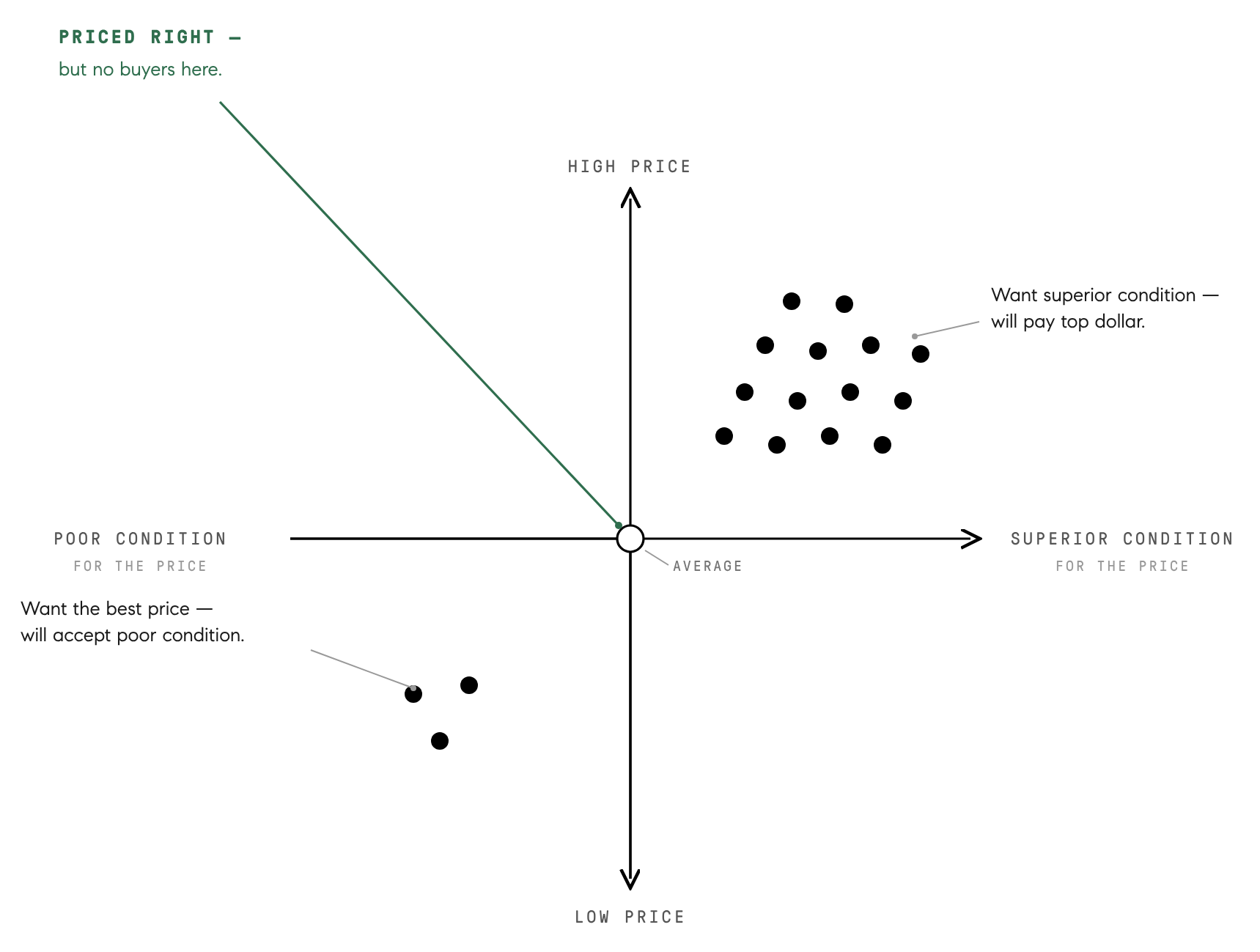
Condition splits that pool in two. The larger group wants a home in strong condition and will pay for it. The smaller group wants the lowest price and will accept poor condition. Almost no one is shopping for average. An average home priced at its correct average value looks fair on paper and still does not sell.

The buyers who pay the most have been searching longest and have already lost a home or two. They see your home the week it comes on. After that, showings slow, and a buyer who has passed rarely comes back.

What it means for you: aim your home at one buyer pool, not the gap between them, and be ready before you launch.

Diagram: buyers who want superior condition and buyers who want the lowest price sit in two clusters; an average home priced at the midpoint sits where there are no buyers.
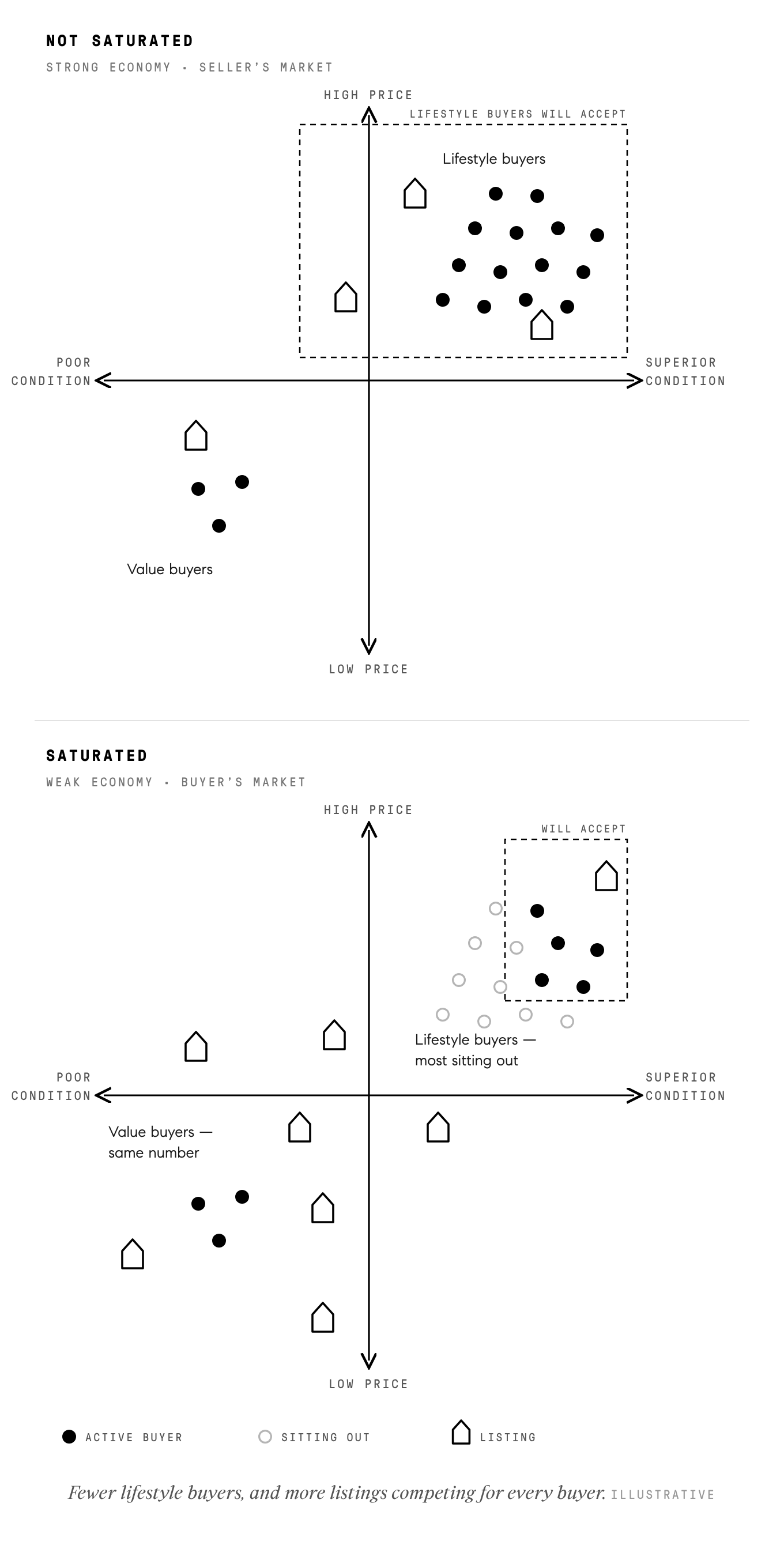
Two condition-by-price charts. Not saturated: many active lifestyle buyers who accept average homes, few listings. Saturated: most lifestyle buyers sitting out, the same value buyers, and more listings everywhere.

QUESTION 2 OF 5

How much competition exists for those buyers?

Buyers compare a small set of similar homes: same price range, area, size and condition. That set is your competition. Many buyers and few homes, and buyers compete. Few buyers and many homes, and sellers compete.

The same neighborhood can hold both at once. Two homes on the same street can be in different markets, because buyers don't search on location alone. They search for a specific kind of home within it.

When too many homes chase the same buyers, a listing has to stand out on price, condition, presentation and terms. Otherwise the market forces price cuts.

How the economy shifts the pools

Lifestyle buyers shop from a wish list. When the market is not saturated, in a strong economy and a seller’s market, they make up most of the buyers and will accept a home that misses a few items. When the market is saturated, in a weak economy and a buyer’s market, fewer of them are looking, and the ones who are won’t accept a home that misses.

Value buyers never change their rule: the price has to be a deal. Their numbers hold steady, so they become a larger share of the buyers still looking. Meanwhile listings rise at every price and condition, because sellers who would have waited come to market without putting their homes in top condition.

So in a saturated market, a good home that misses the wish list and isn’t a deal has no buyer.

What it means for you: you are competing with what is for sale now, not with what sold last spring. Launch when you can win against your relative competition.
QUESTION 3 OF 5

What will buyers compare your home against?

Buyers build their comparison set on Zillow, Redfin, Realtor.com and brokerage sites: new listings, price cuts, homes they saved weeks ago. They also compare your home to the one they hope will come on next week.

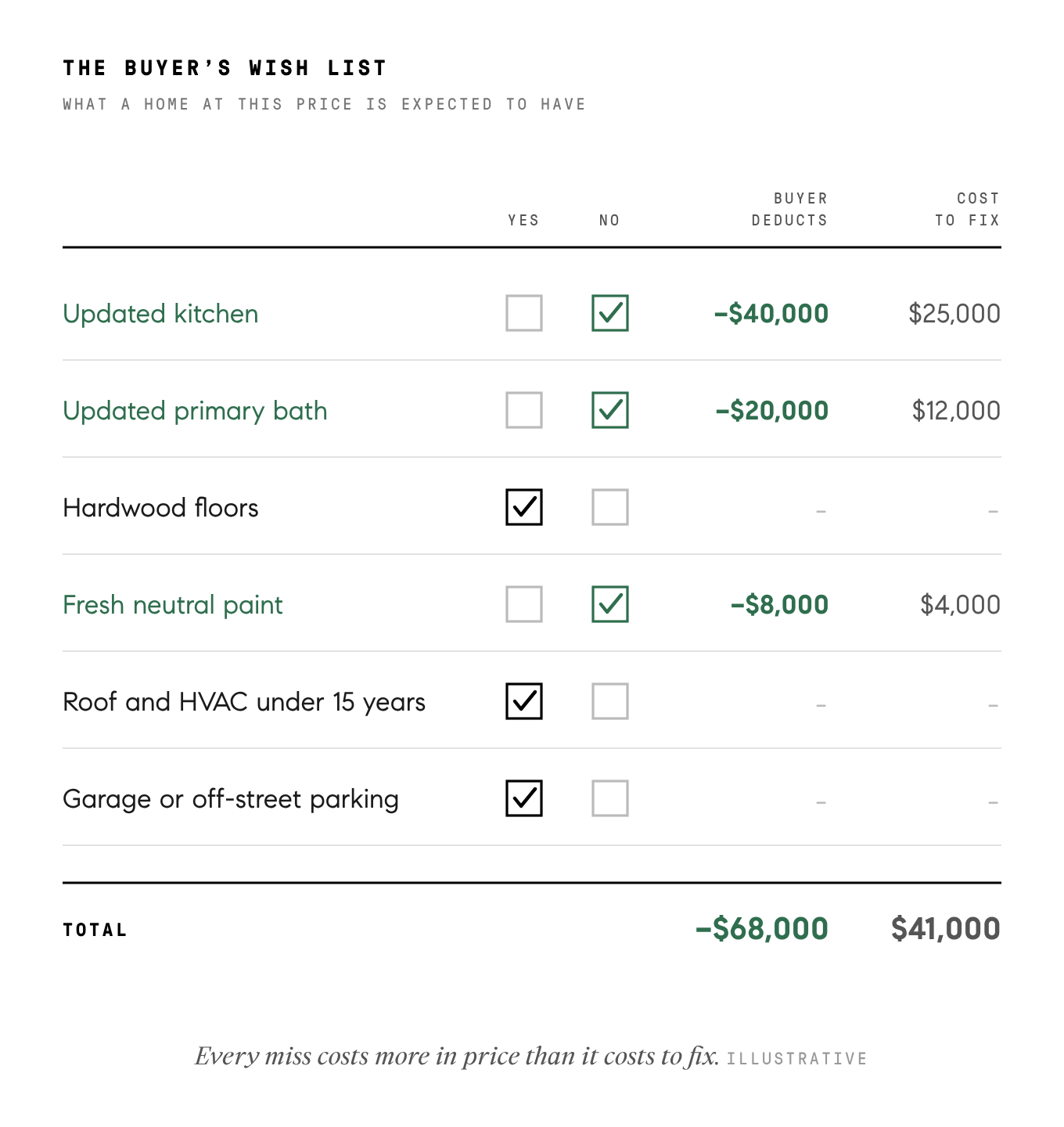
They judge every feature against what a home in your price range is supposed to have. Buyers don't pay premiums for features that beat that baseline. They charge penalties for features that fall short, and the penalty is bigger than the cost of the fix.

My Home Audit scores every feature that matters from −2 to +2 against that baseline, then decides which penalties are worth erasing before you list and which to price around.

What it means for you: your home does not have to be perfect. It has to look like the best choice available right now, with no penalty a buyer can use against you.

A buyer's wish list for a home at this price, marked yes or no. Each miss shows what the buyer deducts and what the fix would cost; deductions total more than the repairs.
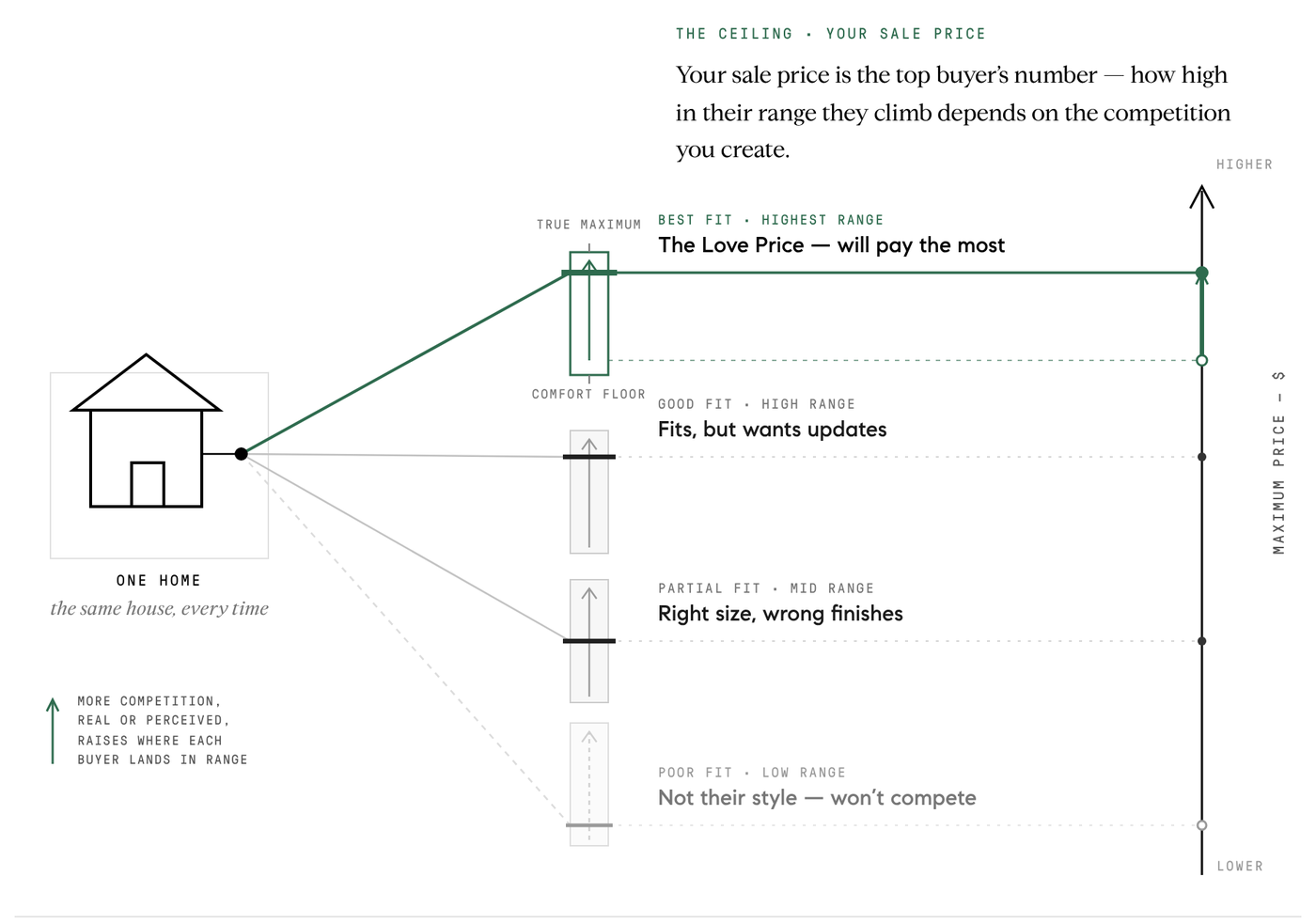
Diagram: one home, four buyers with different price ranges; the best-fit buyer's maximum sets the sale price.

QUESTION 4 OF 5

What price makes buyers stop searching?

There is no single price for a home. Each buyer has a range, from a price they would love to pay up to a true maximum. Where that maximum sits depends on how well your home fits what they want.

Your sale price is the top buyer's number. How high in their range they go depends on competition, real or expected. A buyer who loves the home assumes others will too, and moves toward their maximum on their own.

The price where that happens is what Australian agent Peter Hutton calls the Love Price: the point where a buyer thinks, "If we don't act now, someone else will buy this home." The buyer stops comparing and starts competing.

What it means for you: price at the number that makes the right buyer stop comparing. A buyer who doesn't feel compelled to act will keep looking.

What mispricing costs

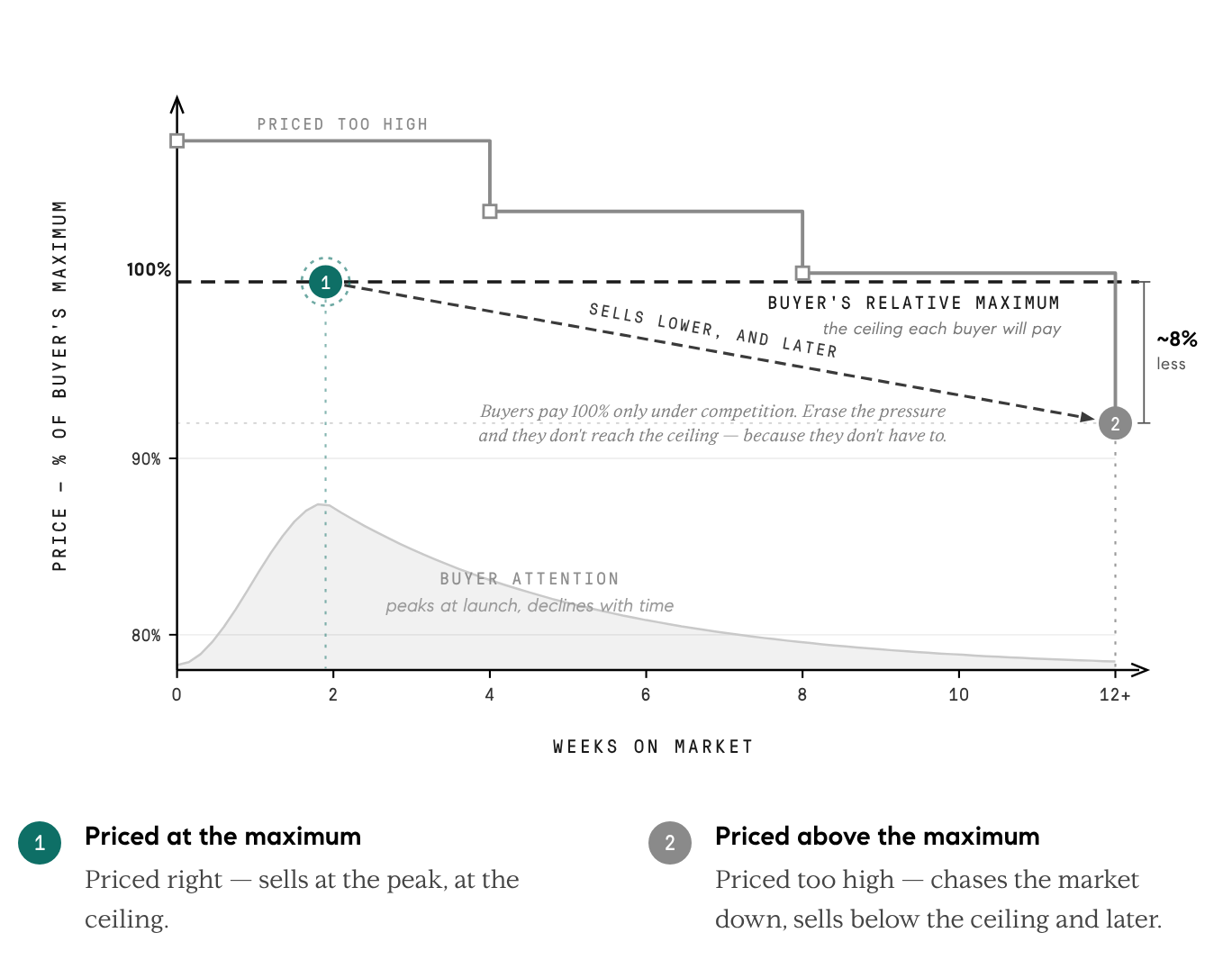
A price is only right relative to what buyers are comparing it with. Price above what buyers will pay for your home against its competition, and they don't make offers. Not even low ones. The home sits, and showings fall off as the strongest buyers move on.

From there, you're waiting on new buyers to enter the search. A rising market can rescue an overpriced home. A flat or falling one usually can't, and each week makes the gap harder to close.

Typically the home only starts to move once the price falls below the number buyers already had in mind. By then the buyers who would have paid the most are gone. It sells later, and for less than if it had been priced right on day one.

What it means for you: price is how you tell buyers to act now. Mispriced, it tells them to wait. Lifestyle buyers respond to condition. Value buyers respond only to price.

Chart: a home priced at buyers' maximum sells at the peak in about two weeks; one priced above it chases the market down and sells about 8% lower, later.
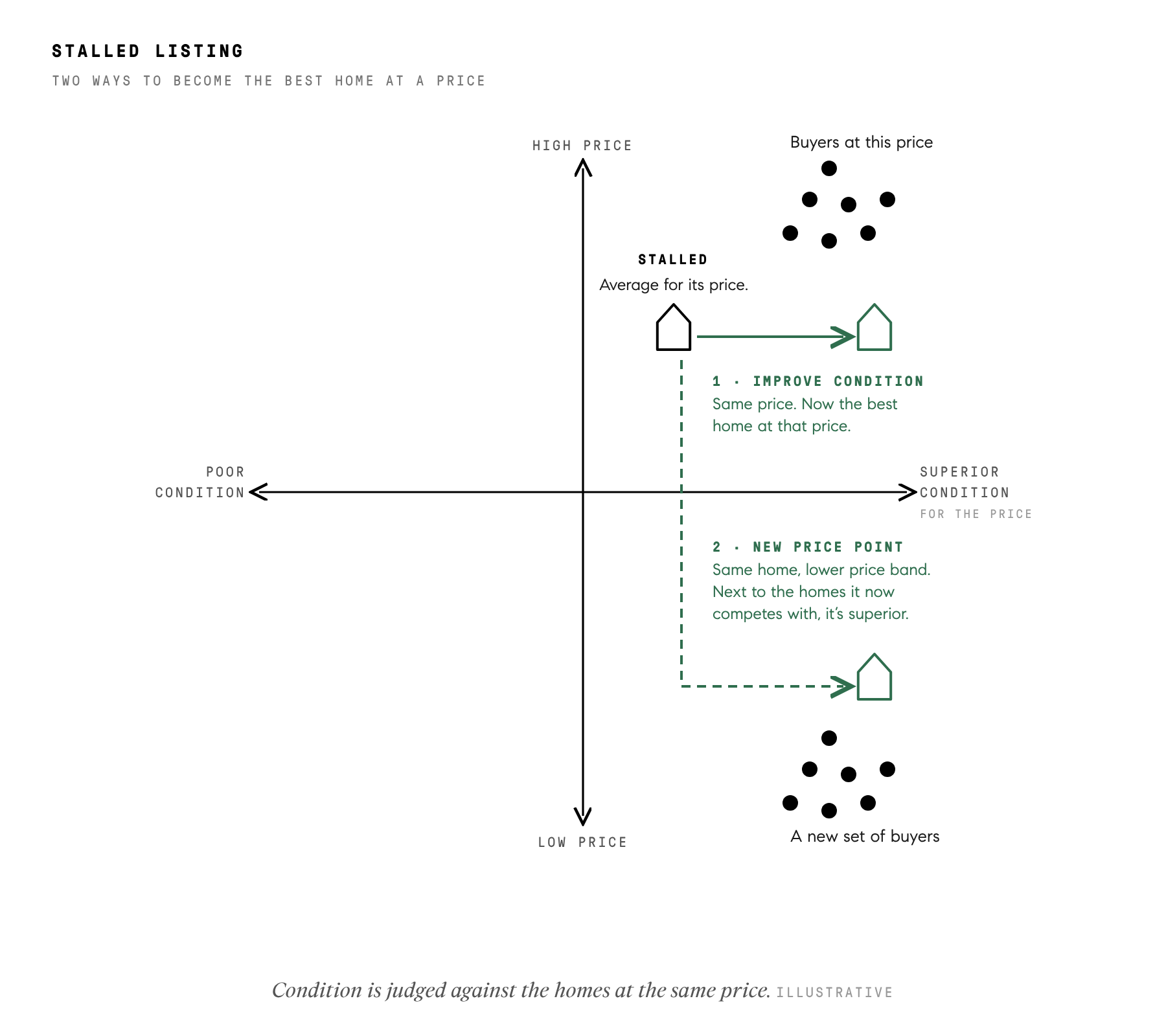
Condition-by-price chart. A stalled home, average for its price, either improves condition to become the best home at the same price, or moves to a lower price point where it is superior to the homes it now competes with.

Two ways out of a stalled listing

A home's condition is never judged on its own. It's judged against other homes at the same price. That's why a stalled listing has two ways out: improve it until it's the best home at its price, or move it to a price where it already is.

Small price cuts do neither. The home stays average for its price, and the buyers at that price keep passing.

What it means for you: if your listing has stalled, choose one of the two ways out and commit to it. Waiting for a rising market to rescue it is luck, not a plan.

QUESTION 5 OF 5

What are you willing to spend to get it?

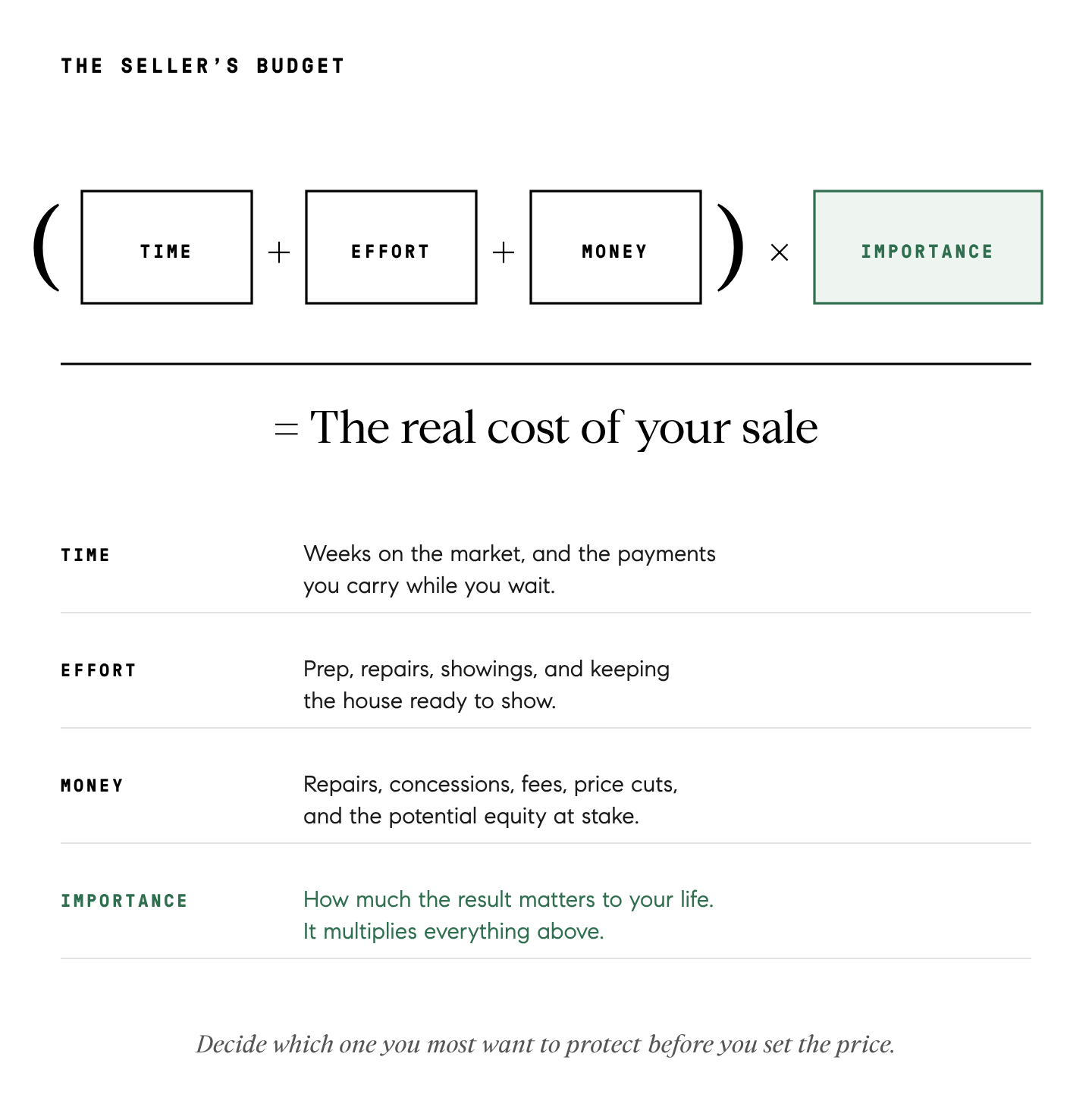
Every way of selling a home costs time, effort and money, and how much the result matters to your life multiplies all three. No strategy keeps all three low. Holding out for the top price usually costs time and effort. A fast sale usually costs money. A quiet sale can cost money or time.

Where your home is offered changes the budget

On the MLS, the most buyers see your home at once, which gives you the widest competition for the price. It takes more effort, between prep and showings, and your days on market are public. Off the MLS, fewer buyers see it. You control who sees it and whether the price is shown, and there’s no public record if it doesn’t sell. That privacy can cost you money or time.

What it means for you: decide which of the three you most want to protect before you set the price. Most seller regret comes from spending more of one than you planned.

The seller's budget: (Time + Effort + Money) multiplied by Importance equals the real cost of your sale.

What Sellers Regret, and the Question That Prevents It

Every listing ends one of two ways. Buyers compete: multiple offers, stronger terms, a faster sale, a higher price. Or sellers compete: fewer showings, price cuts, more days on market, negotiating from weakness.

In a 2026 survey of 1,000 recent home sellers, about 70% had regrets about their sale. Each of the top regrets traces back to one of the five questions going unanswered before the home went on the market.

What sellers saidShareThe question that prevents it
"We underestimated what it would cost to sell."16%3 and 5. The Home Audit prices every fix before launch, and your money budget is set up front: repairs, closing, concessions, marketing.
"We didn't sell for enough."15%4. Price set at the Love Price against active competition, not wishful thinking.
"We should have negotiated more."14%1 and 2. Leverage comes from competing buyers. Launch to the strongest pool, when the field is thin.
"Commission was too high."12%5. The fee is part of your money budget, set in writing before you list.
"We sold at the wrong time."12%2 and 5. A launch date set against local supply and your time budget. If waiting a few weeks helps, I'll say so.

Sellers in the survey expected to spend $26,883 on their sale. The average was $81,918. 69% said they would have made different decisions had they known the true cost in advance.

Source: Clever Real Estate, "True Cost of Selling a Home: 2026 Edition," October 26, 2026. Survey of 1,000 U.S. adults who sold a home since 2024, fielded August 13–16, 2026.

Calibrate your home before buyers see it.

I'll answer the five questions for your home and show you what to change, if anything, before you list.