How's the Alexandria Market? October 2026
Alexandria detached homes: buyers are still touring, but supply hit a five-year October high. What that means for selling now or next spring.
11 min read

Short answer: If you plan to sell in spring 2027, expect more competition than in spring 2026, especially for townhomes and condos. Three things will decide how your sale goes: supply, condition and concessions. The homes that sell quickly will be the ones priced and prepared right from the first day.
What I mean by spring 2027: January 1 through May 31, 2027. The season starts when sellers begin listing after the holidays and buyers come back in January. It ends as the market moves into summer.
This is my forecast, written in November 2026. It's based on what Bright MLS data shows now, compared with past years that had similar trends. I'll update my prediction through the winter. If you want the updates, subscribe.
In my experience, buyer demand stays fairly steady year over year. What changes is how many choices buyers have. In other words, the number of homes for sale relative to demand decides which way prices move.
For the week ending November 15, 2026, the Washington, D.C. metro area had 12,218 homes for sale, 23% more than the same week in 2025. Buyers signed 854 contracts, 14% fewer. Showings were down 16%. The median home took 48 days to go under contract, 11 days longer than a year earlier. 163 sellers canceled their listings, up 79%.
In Fairfax County, 2,008 homes were for sale, up from 1,444 a year earlier. Alexandria City had 451, up from 332.
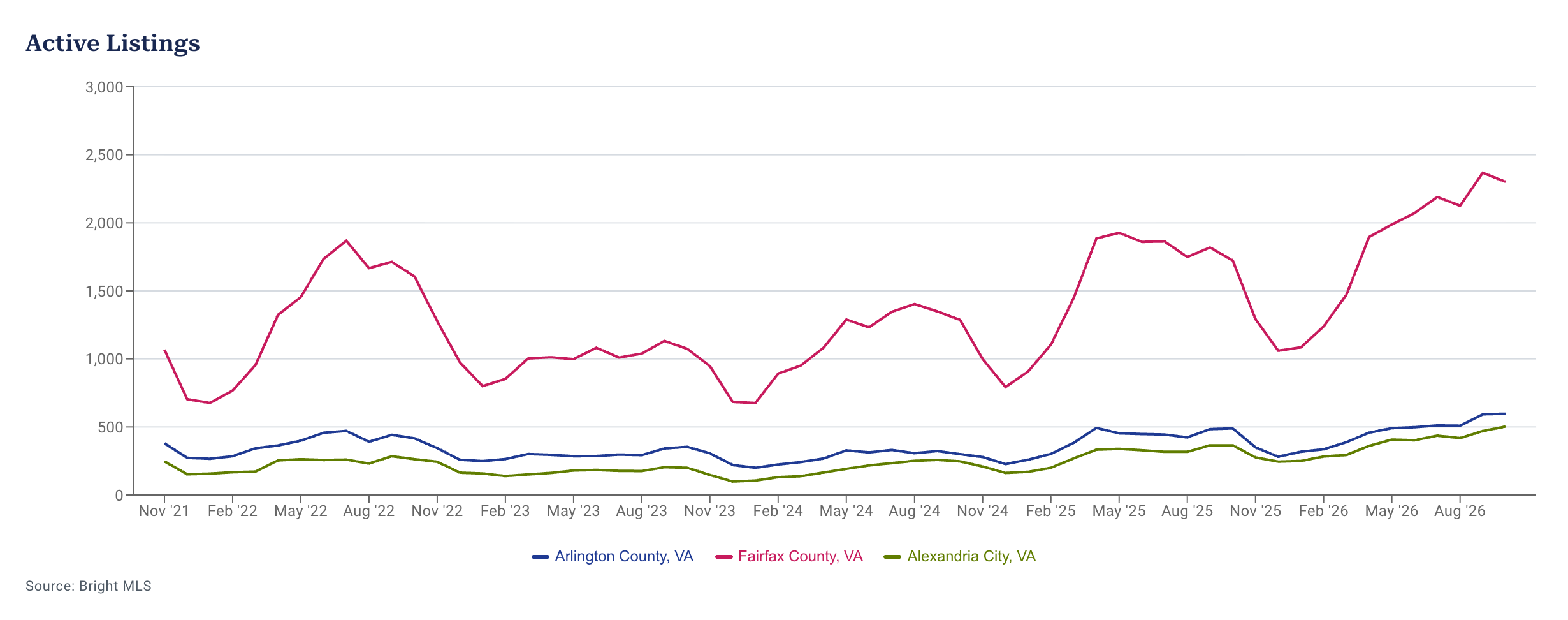
Fairfax County is at its highest level in five years, and last winter's low was the highest of any winter on the chart. Monthly figures; the weekly counts in the text are measured differently. Source: Bright MLS; data reliable but not guaranteed.
Mortgage rates are higher than a year ago. Freddie Mac's weekly survey put the average 30-year fixed rate at 7.11% for the week ending November 11, the fourth weekly decline in a row.
Many of the sellers who canceled in fall 2026 plan to try again in January. They'll come back on top of the homes still unsold and the usual new listings.
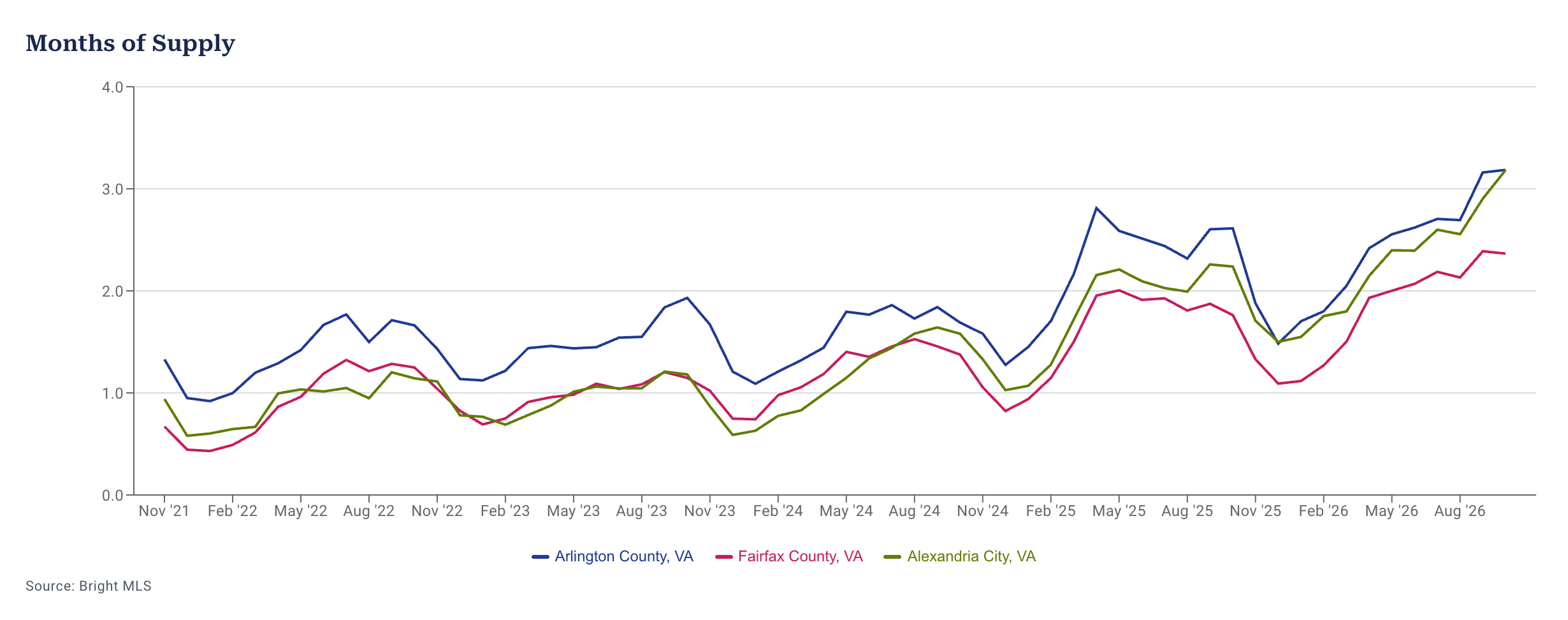
Months of supply is how long it would take to sell every home for sale at the current pace. In fall 2021 all three were under about 1.5 months. In October 2026, Arlington and Alexandria were at about 3.2 months and Fairfax at about 2.4, the highest in five years. Source: Bright MLS; data reliable but not guaranteed.
Northern Virginia has seen rising inventory before. What happened next depended on rates and on how tight supply already was.
2007–2008. In early 2007, inventory was rising, sales were flat and prices were slipping. The buildup kept going until spring 2008, when Northern Virginia had more than 12,000 active listings, about nine for every sale. That market also had a wave of foreclosures and short sales, which today's market doesn't. It also faced a dramatic reset to how lenders were underwriting loans, and what buyers were qualified to buy, which today's market doesn't.
2018–2019. Inventory rose through 2018, a year that ended with the Amazon HQ2 announcement and the longest federal government shutdown to that point. Then rates eased. Virginia's inventory fell every month in 2019, prices rose and homes sold faster. That's spring 2027 if rates fall.
2022–2023. Rates near 7% cut buying sharply. In March 2023, D.C.-area pending sales were down about 28% from a year earlier, but homes still sold quickly because there was so little for sale. Northern Virginia's median sales price in April 2023 was up slightly from a year before. Rates today are similar, but supply is the opposite. It isn't scarce anymore.
2025. Federal uncertainty arrived. In April 2025, D.C.-region pending sales were 2.5% lower than a year earlier, showings were down 8.1%, and the number of homes on the market was up 29.2%. Fall 2026's numbers are higher still.
My read: Today looks most like 2007 without the foreclosures or lending crisis. Supply is growing faster than buyer demand. The rate path and consumer confidence likely decide whether it turns into 2019 instead.
The extra supply isn't spread evenly. In NVAR's August 2026 report, local inventory gains came mainly from condos and townhomes, while detached-home inventory declined. I expect detached homes to hold up better in spring 2027, and townhomes and condos to face most of the competition.
In addition, not every buyer is equally matched or motivated. Some buyers are stretched thin on affordability and others are in strong cash positions. If you are paying cash for a home, the current rate isn't an issue for you. Likewise, if you are having your third kid and live in a one bedroom condo, chances are you will figure out a way to buy a home. Even if you have to move further out to afford it.
Every market has buyers at the top and buyers at the bottom of the price axis.
Premium buyers bring significant equity or cash, care more about location and condition than about the rate, and pay for a home that's finished and ready to move into.
Value buyers are looking for the lowest price. Many are investors and flippers who need room between what they pay and what they can resell for, after the cost of the work. In a flat or falling market that margin disappears, because a flipper can't count on resale prices holding while the work gets done. In my experience, most of them stay on the sidelines in a market like this one. Others in this group are stretching to afford a home, and every quarter point on a mortgage rate changes what they can pay.
High rates and flat prices thin out the value buyers, and premium buyers keep buying. We saw it in early 2023, when Bright MLS noted that many buyers were bringing significant equity or cash to the deal even as higher rates made buying harder for others.
That's why I expect premium neighborhoods and move-in-ready homes to outperform the market in spring 2027. The softness will show up mostly where value buyers usually carry the market: entry-level townhomes and condos, and homes that ask the buyer to take on work. With fewer flippers out there, an as-is house has fewer buyers than usual.
If you want to sell to premium buyers, the house has to meet their standard. Premium buyers buy premium homes. Discounting a house they don't like doesn't motivate them to buy it.
If you owned Apple stock and decided to sell, you'd look up the price, sell at it, and get on with your day. You wouldn't hold out because you'd bought at a higher price, or because a friend sold for more last year. The market price is what buyers are paying today.
A house works the same way. It's harder because your life happened there. You remember what you paid, what you spent on the kitchen, and what the house down the street sold for in 2022. Buyers don't see any of that. They see your house next to every other house for sale that week, and they pay what it's worth compared with those.
A house is also an all or nothing transaction. With stock, you can sell some shares now, see how the price holds, and sell the rest later. You can set a sale price and when the market hits it, sell. With a house there's one sale, to one buyer, at one price. You can't sell a portion of it to test the market. That makes getting the price right the first time matter more.
When more homes are for sale, the gap between what the house means to you and what buyers pay matters more. Most of the homes that struggle to sell in spring 2027 will be priced on what the house means to the seller rather than on what buyers are paying. This is because once a seller settles on what they "think" the house is worth, they struggle to catch up to a market that won't pay it.
A house has one big advantage over a stock: you're in charge. As an Apple shareholder, you own a sliver of the company and have no say in how it's run. With your house, you're the board of directors, the CEO and the majority shareholder. You decide the price, the condition, the timing and how it's marketed. You can repair, clean and prepare it so it competes with better homes. Price and condition are the two decisions that matter most, and both are yours.
A concession is money the seller puts toward the buyer's closing costs, repairs or a lower mortgage rate. It's the second price in this market: the discount that doesn't show up in the asking price.
Concessions are now common. Redfin reported that 42.8% of Washington, D.C.-area sales in the three months ending May 2026 included one, up 4.5 percentage points from a year earlier. Nationally, 44.7% of August 2026 sales included a concession, the highest share for that month since 2020, and 15.8% combined a concession with a price cut.
That's a drag on what sellers walk away with. The sale price is what gets reported, but a concession comes out of the seller's proceeds at closing. When nearly half of sales include one, nearly half of sellers are converting less of their equity into cash than the sale price suggests. So even where median prices look flat, more sellers are paying to close the deal. In October 2026, the D.C. region's median sale price fell 0.8% from a year earlier, its first year-over-year decline in more than three years, according to Bright MLS. With concessions on top of that, the net is lower still.
Close to home, the numbers show it. In Arlington, Alexandria City and Fairfax County, 39% of the homes that sold from July through mid-November 2026 included a seller concession, typically about 1.4% of the price. After price cuts and concessions, nearly 4 in 10 sellers netted at least 3% less than their original asking price, and about 1 in 4 netted 5% or more below it. For condos, it was half. Source: Bright MLS; data reliable but not guaranteed.
A year earlier, only about 1 in 5 Fairfax County sales included a concession; this year it's about 2 in 5. For most sellers, the concession took the place of a price cut, and what they netted was close to last year. Condos are the exception: half of condo sellers netted at least 3% below their original asking price, up from about a third a year earlier. Source: Bright MLS; data reliable but not guaranteed.
Who they're for. Concessions mostly help the buyer who is stretching to qualify. A buyer with significant equity or cash doesn't need a closing-cost credit. That's why I expect concessions to be heaviest in the same places I expect the market to be softest: entry-level townhomes and condos.
A credit can do more for the buyer than the same price cut. By my rough math, at today's rates, $10,000 off the price lowers a buyer's monthly payment by about $65. The same $10,000 used to buy down the interest rate on a $600,000 loan can lower it by two to three times that, depending on how the lender prices it. It costs you the same either way, but the buyer feels the payment.
A concession protects the asking price. A price cut doesn't. A normal, reasonable concession doesn't change the appraised value. A price cut is public. It stays in the listing history and tells every buyer watching that the price was too high. A concession is negotiated with the one buyer who's ready to buy. Loan programs limit how much a seller can contribute, so it isn't unlimited.
Repair credits are the cost of skipping condition. In my experience, buyers estimate repairs at two to three times what they actually cost, and they negotiate from their estimate. Fix it before you list and you pay the real cost. Leave it for the inspection and you pay the buyer's estimate.
Mostly not in this market.
A low price starts a bidding war only when more buyers show up in the first few days than there are homes like yours. In 2021, a low price pulled every buyer into the same weekend, and they bid each other up because the next house might not exist. Now there's more for sale, fewer buyers are touring, and buyers know there will be another house next week. When buyers aren't afraid of losing, a low price gets them to show up, but it doesn't get them to compete.
Concessions make it worse. Your list price anchors what buyers think the house is worth. If you list low and no bidding war comes, the low price becomes the ceiling, and a buyer who expects a concession negotiates it off that already-low number. You get hit twice. And because a house is all or nothing, there's no taking it back.
It can still work for detached homes and/or in premium neighborhoods, where inventory is still tight and premium buyers are active. Everywhere else, the strategy that holds up is to price your home as the best choice among the homes it competes with, at a number you'd actually accept, with the condition done. Buyers settle on the best home in their price range within its first two weeks on the market. It has to be the best choice, but it doesn't have to be underpriced.
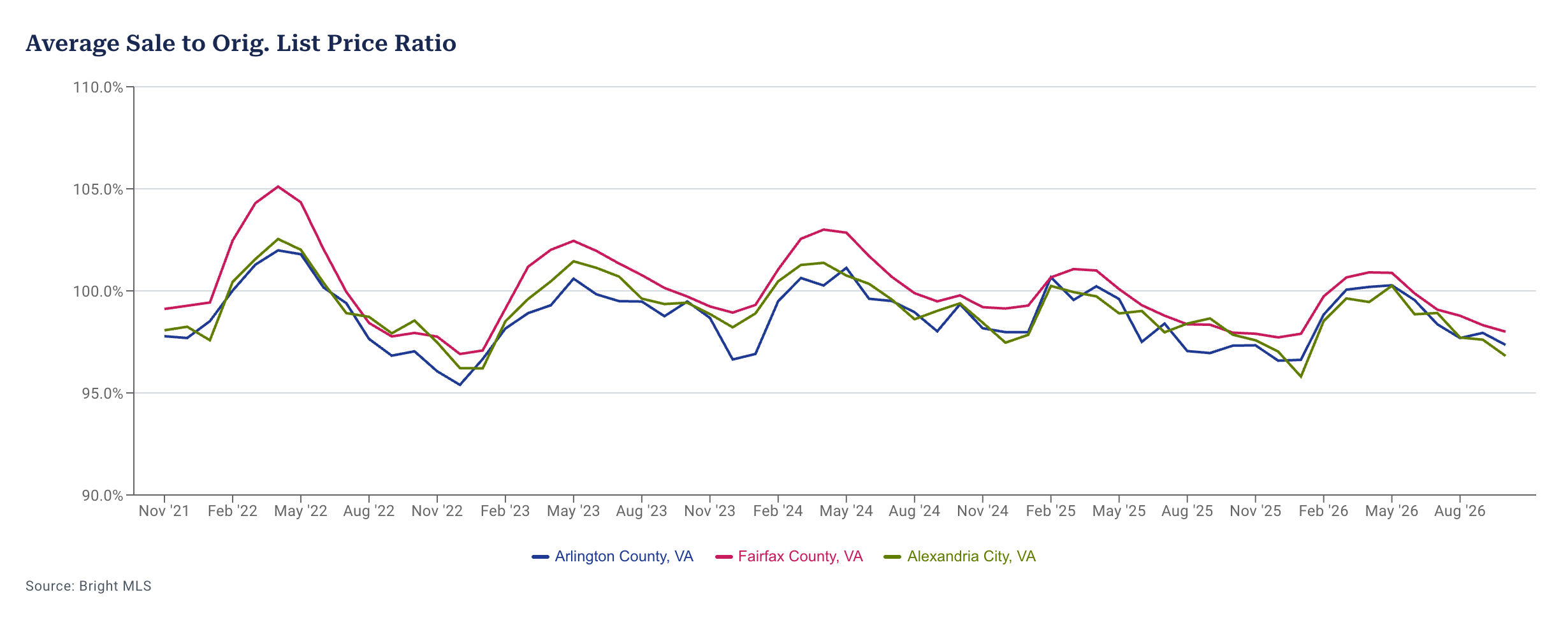
In Fairfax County, the spring peak fell from about 105% of original asking price in 2022 to about 101% in 2025 and 2026. By October 2026, homes in all three were selling for about 97–98% of original asking, before any concessions. Source: Bright MLS; data reliable but not guaranteed.
Buyers will be out, but fewer of them than in early 2026, and they won't be in a hurry. They can see how much is for sale. Sellers coming back in January will find many others with the same idea.
Contracts pick up with the season, but supply grows faster. Homes take longer to go under contract than in spring 2026. Price cuts and concessions become even more common by April. Homes that are priced right and in good condition will still go under contract quickly, often within the first week or two. The ones that miss on price or condition will sit, cut, and sit again.
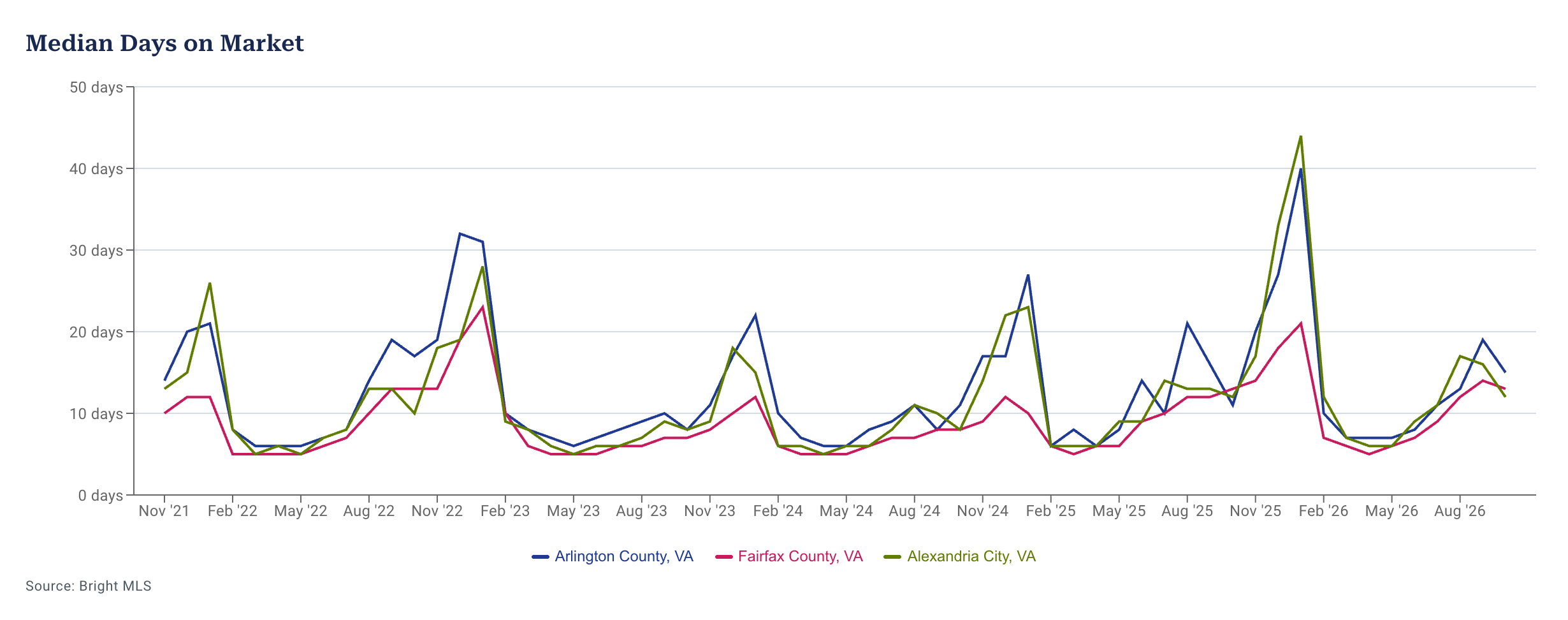
Every winter, days on market jumps; every spring, it falls back to about a week. In spring 2026, half of the homes that sold in all three went under contract within about five to seven days. Source: Bright MLS; data reliable but not guaranteed.
Sellers who listed early and haven't sold start pulling out or making bigger cuts. I expect median prices to end up flat to slightly lower than spring 2026, with townhomes and condos softer than detached homes, and more sales including a concession than a year earlier.
These are the numbers that would move this forecast one way or the other. I'll report on them through the winter.
Bottom line: you can win in any market. You just have to know how the market is working and what you need to do to position your home correctly.
Every great move starts with a conversation. Let's start yours.
Data: Bright MLS Weekly Market Report, week ending November 15, 2026, all residential property types; Bright MLS, Bright Stats, Arlington County, Fairfax County and Alexandria City, VA, monthly data November 2021 through October 2026, accessed November 18, 2026; Bright MLS closed sales in Arlington County, Alexandria City and Fairfax County, July 1 through mid-November 2026, and Fairfax County for the same period in 2025 (detached, townhouse and condo). © Copyright Bright MLS. Information deemed reliable but not guaranteed. Mortgage rates from the Freddie Mac Primary Mortgage Market Survey. Purchase application data from the Mortgage Bankers Association. Concession data from Redfin and Bright MLS. Historical figures as reported by Bright MLS, NVAR, Virginia REALTORS® and local press for the years cited. The forecast is my own.

Alexandria detached homes: buyers are still touring, but supply hit a five-year October high. What that means for selling now or next spring.
Pending home sales fell 16.4% while inventory rose just 2.1%. What the latest housing numbers mean for Northern Virginia homeowners thinking about...

Selling an inherited Northern Virginia home? When probate is needed, how qualifying at the circuit court clerk works, the probate tax, and the...