Should I sell my house before I retire?
Retiring in Northern Virginia? How to decide whether to sell before or after you retire, and why financing your next home is easier while you're...
6 min read

Most sellers start in the same place. They want to know what their home is worth. It is the right question. The honest answer is that the number they are looking for does not exist the way they think it does.
The industry has trained sellers to think about value the way Newton thought about the world. Newtonian physics treats space and time as fixed and absolute. A foot is a foot, a second is a second, everywhere, for everyone. Apply that to real estate and you get the assumption almost every seller carries: that their home has one true value, a fixed number sitting out there waiting to be discovered, and that the job of an appraisal or a list price is to find it.
That assumption is wrong, and it costs most sellers time and money.
Value is in fact relative, not absolute.
Enter Albert Einstein. Einstein's insight was that measurements of space and time are not fixed facts. They depend on the frame of the observer, and two observers moving differently will measure the same event differently while both are correct.
Your home behaves the same way. Its value is not a metric the house owns. It is the point where one specific buyer's frame of reference meets yours, on one specific day, under one specific set of market conditions.
Put two qualified buyers in front of the same house on the same morning and they will not arrive at the same number. One sees the kitchen they always wanted. The other sees a renovation they will resent. Same house, same day, two different values. Neither buyer is wrong.
There is no privileged observer who holds the real number, because the real number does not exist independently of the buyer measuring it.
Each buyer who walks through your home carries two numbers. The first is the price they would love to pay. The second is their true maximum, the most they will spend before they walk away. Between those two numbers is that buyer's range.
How wide and how high that range sits depends on fit. How well does the home match what this buyer is looking for? The buyer who finds the right size, the right finishes and the right location has the highest range of anyone. The buyer who likes the location but wants to redo the kitchen sits in the middle. The buyer for whom the home is the wrong style sits low and will not compete at all.
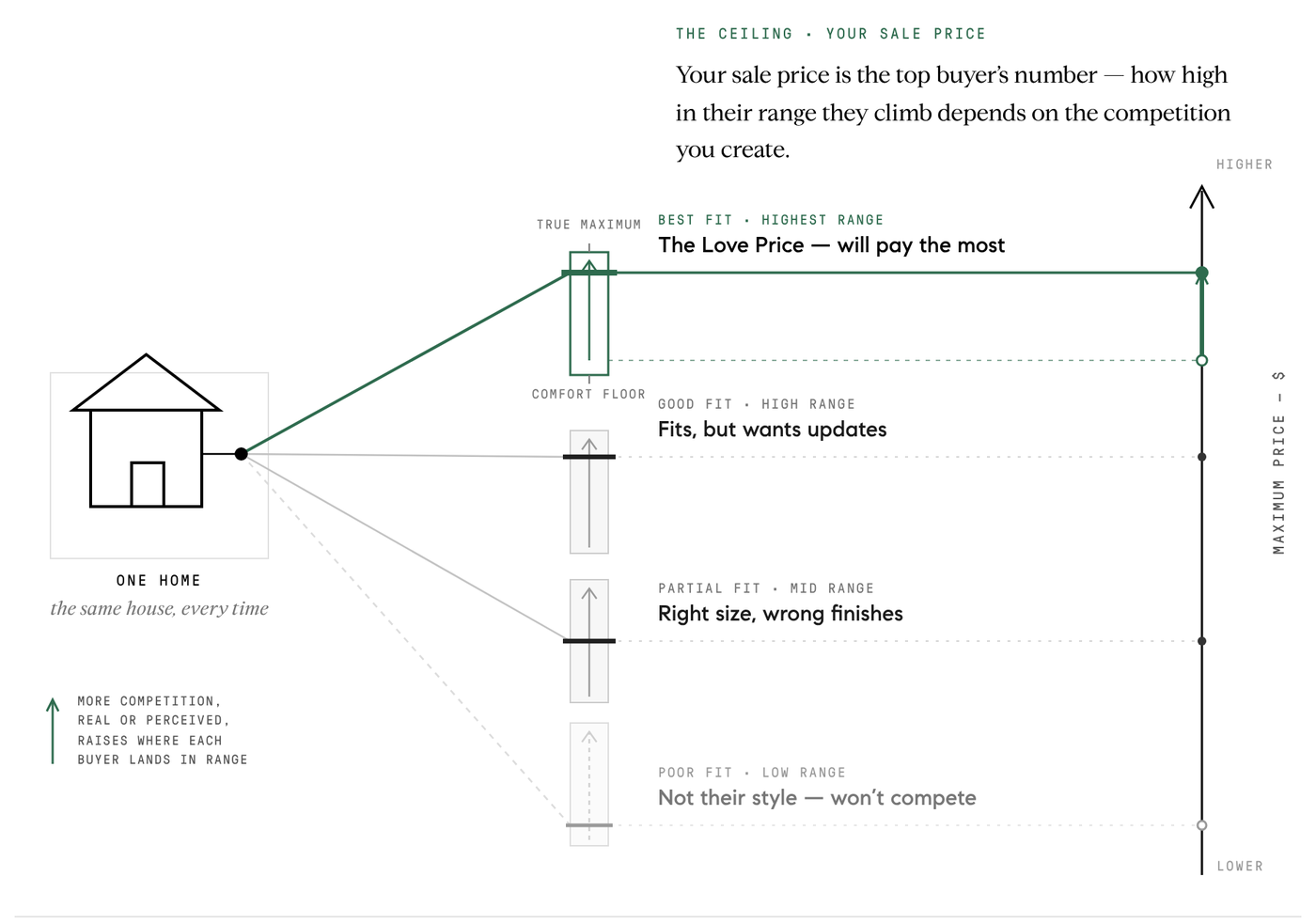
Line those buyers up and the picture is clear. The same house, every time, with a different range for each buyer. Your sale price comes from one of them. It is the number of the top buyer you reach, and where that buyer lands inside their own range.
Your sale price is a fact about which buyer you reach, and how high in their range they climb.
So your home does not have a price. It has a distribution of possible outcomes. Where you land inside that distribution is not luck, and it is not fixed. Two forces move it.
The first is condition. It is the one variable you control. Buyers today are not making the careful adjustments an appraiser makes. They are not standing in your living room subtracting fifteen thousand dollars for the carpet. They decide in minutes whether this is their house. If it is, they stay. If it is not, the next listing is one click away. Condition is what moves your home up or down against the homes it competes with in the buyer's frame.
Condition also decides which buyers show up at all. Buyers separate into two pools. The larger pool wants a home in strong condition and will pay for it. A smaller pool wants the lowest price and will accept poor condition in exchange.
The home in average condition sits between those two pools, and that is a trap. Priced at its correct average value, it is fair on paper and still does not sell, because almost no one is shopping for average. An appraisal adjusts value. It splits the difference and lands in the middle. Price a home by that logic and you get a defensible number pointed at the emptiest part of the market.
The fix is to aim the home at one pool or the other. Prepare it for the buyers who pay for condition, or price it for the buyers who want a deal. Splitting the difference appeals to no one.
The second is competition. How many of the right buyers observe your home at the same moment. One buyer negotiating alone behaves one way. Three buyers who all want it behave very differently. The work is to put your home in front of as many of its actual buyers as possible, at once, so that the value the market will bear is the value that shows up.
Competition does not have to be visible to work. A buyer standing alone still climbs toward the top of their range if they believe others will want the home too. If they love it, they assume someone else will. When buyers sense real demand, strong traffic, real interest, offers expected, they move toward their maximum on their own.
That perception has to be grounded in real activity. Buyers and their agents have been watching the market for months. They know what a quiet listing looks like, and they know what a busy one looks like. Exposure and presentation create both the real competition and the sense of it, and in my experience the sense of it moves price almost as much as the competition itself.
Timing matters for the same reason. The buyers with the highest ranges are usually the ones who have been searching longest and are ready to act. They see a new listing in its first days. If the price or the condition is wrong when they see it, they move on, and the buyers who come later tend to sit lower in their ranges.
No buyer starts their search knowing their true maximum. They learn it.
A buyer who has been in the market for weeks, having lost out on competing offers on competing homes, has a much better sense of what's working and what's not. The same is true for a seller who has failed to sell.
Both learned the same lesson the expensive way. The market taught them where value sits by charging them for every misjudgment. The buyer paid in lost homes. The seller paid in weeks on the market and price reductions.
A seller can learn that lesson before the market charges for it. That is most of what good advice is worth. Knowing what the buyers in your price range have already seen, already lost and already learned lets you price and prepare your home for the buyer they have become.
This relativity is also why I am skeptical about a phrase sellers love to hear: sold over asking. Selling at 103 percent of the asking price sounds like a win. Often it is not. The asking price is not a fixed reference point either. It is a number the agent chose. An agent can set the price low on purpose, create a bidding rush, and produce a high percentage over a figure they selected themselves. The percentage looks impressive. The dollars may be ordinary.
Here is a simple illustration. Two identical homes sit on the same street. The first lists at $750,000 and sells for 103 percent of asking, $772,500. The second lists at $825,000 and sells for 97 percent of asking, $800,250. The first seller gets the better headline. The second seller walks away with $27,750 more.
The percentage is measured against a moving reference point the agent set. It is a tactic, not a result. The only number that matters is the one you walk away with, measured against what you actually wanted from the sale, in the amount of time you have to spend.
If value is relative, what are an appraisal and an online estimate telling you?
Both are useful, and both look backward. An appraisal compares your home with recent sales and adjusts for the differences. An automated estimate does something similar with a formula. Each produces a single number by averaging the outcomes of buyers who already bought other homes.
That is one observer's frame. It describes where similar homes landed. It cannot tell you which buyer your home will reach, how well your home fits that buyer, or how many buyers will be looking at the same time. Treat it as a reference point, then make the decisions that actually move your outcome.
So the question is not what is my home worth. That question assumes an answer that was never out there. The better question is where does my home sit in its range, what moves it, and how do I create the conditions that carry it to the top of that range.
The work is understanding the distribution your home sits in, moving it up through the one lever you control, and creating the competition that decides where inside the distribution you land.
In practice, that comes down to a few questions every seller can ask before listing:
Answer those questions, and the number takes care of itself.
For how I put this to work before a home goes on the market, see the Market Calibration Framework and the Home Audit.

Retiring in Northern Virginia? How to decide whether to sell before or after you retire, and why financing your next home is easier while you're...

Selling one Northern Virginia home to buy another? How to estimate what you'll actually keep after selling costs, your payoff, and the cost of buying...

Moving within Northern Virginia? How to decide whether to buy your next home first or sell first, based on your equity, your timing, and how much...